
The Commission’s proposed Global Europe Instrument (GEI) represents a major rethink of how the EU will fund external action in the next long-term budget. It consolidates existing programmes under a single umbrella envelope, reduces rigid spending targets and expands built-in flexibility. The aim is clear: to make limited resources go further and to allow the EU to adjust its external programmes more quickly as geopolitical conditions evolve. At the same time, it raises questions about the balance between flexibility and predictability, as well as governance and evaluation – all of which will be central to the negotiations ahead.
In July 2025, the European Commission kicked off the fight over the EU’s next long-term budget — and proposed an overhaul of EU external action funding through the Global Europe Instrument (GEI). At its core, the GEI is an attempt to refit EU external spending to a markedly tougher international environment. In the Commission’s words, the instrument should enable the Union to ‘meet the challenges of an increasingly difficult, fragile and volatile geopolitical context.’ Yet the proposal comes at a time when a tight EU budget and rising spending demands at home risk pushing external action to the margins of the broader budget debate.
So what, exactly, is on the table? The instrument follows the design logic of the wider Multiannual Financial Framework (MFF): simplification, stronger coherence and focus, and greater flexibility. It consolidates external action funding into a single instrument, organises spending around geographic pillars that align more closely with internal priorities, and expands reserves to respond to emerging challenges. Key decisions would shift from fixed allocations agreed upfront to later programming stages. The result is not just a larger envelope, but a redesign that could change how the EU sets priorities abroad, how quickly it can redirect resources, and who ultimately gets to decide.
As negotiations unfold, four issues stand out in particular: the debate on a quota for official development assistance (ODA), the balance between programmable and non-programmable funding, the role of different EU institutions in shaping key decisions, and the robustness of reporting and evaluation.
The GEI reflects the same principles that shape the design of the wider MFF (see Table 1). The Commission seeks to simplify external action financing, strengthen coherence and focus, and increase flexibility. These priorities are visible in the instrument’s structure and size, its objectives and its governance.
To simplify funding, sharpen focus and increase flexibility, the Commission proposes to integrate almost all major external action programmes into a single framework and to reorganise how that framework operates. What would this mean in practice?
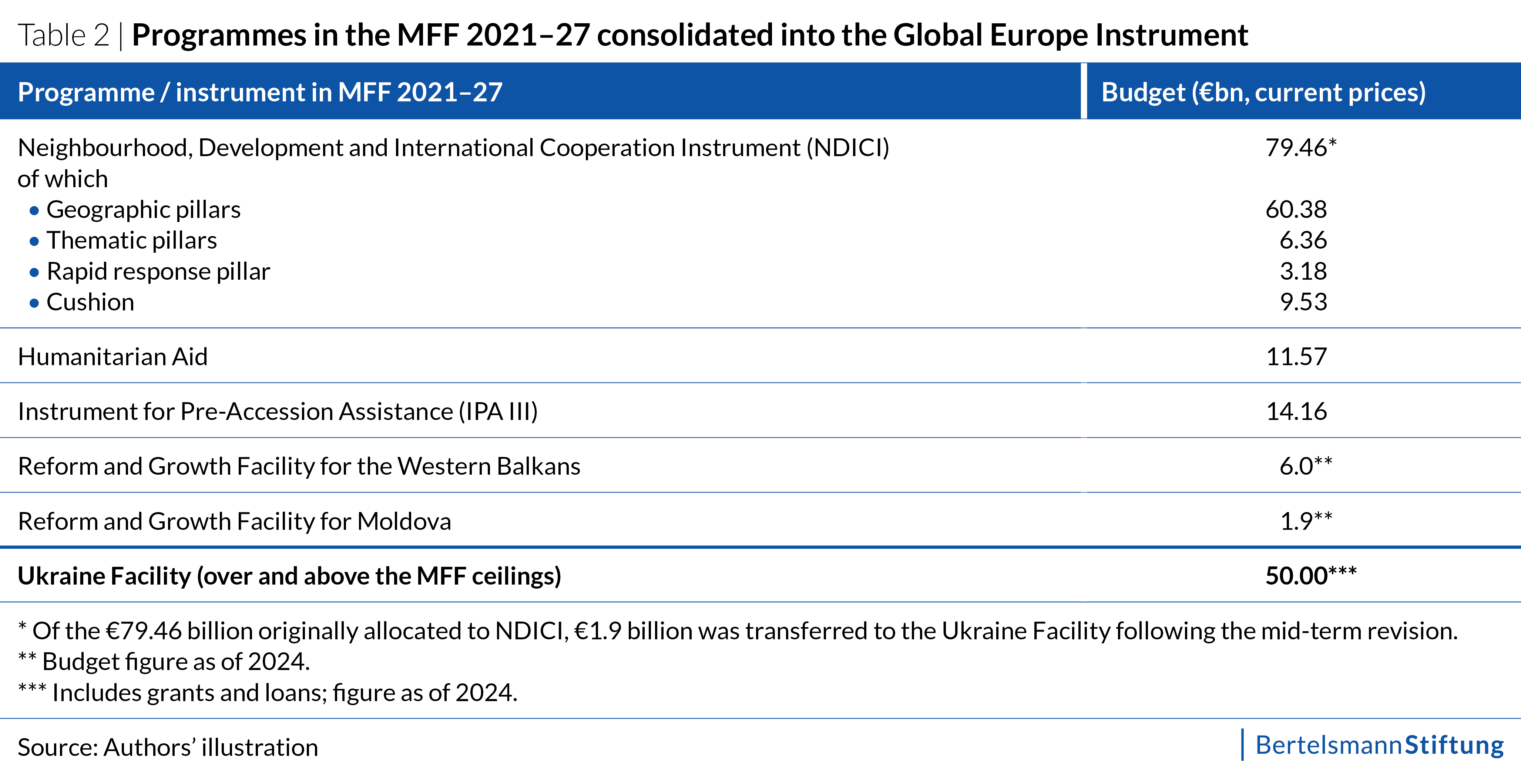
Under the current MFF (2021–2027), EU external action is spread across several instruments (see Table 2). The Neighbourhood, Development and International Cooperation Instrument (NDICI) already consolidated most pre-existing programmes into one structure. However, other instruments remain outside NDICI, including Humanitarian Aid, the Instrument for Pre-Accession Assistance (IPA III), and programmes created after the mid-term review of the current MFF, such as the Reform and Growth Facilities for the Western Balkans and Moldova, as well as the Ukraine Facility.
The Global Europe proposal for 2028–2034 builds on the consolidation trend initiated by NDICI (see Figure 1). It brings existing programmes together under a single external action instrument, governed by a horizontal performance regulation that sets monitoring, reporting and evaluation rules across the entire MFF. Humanitarian aid would retain its own implementing regulation for governance purposes, but its budget would be integrated into the GEI’s overall financial structure.
In terms of scale, the GEI is substantial. The Commission proposes €200.31 billion in current prices – an average of €28.6 billion per year – representing around 10% of the total EU budget. Its share of the MFF would increase by approximately 1.3 percentage points, and its real-terms envelope would grow by nearly two thirds. Negotiations are likely to reduce the headline figure, given pressure from large net-contributor Member States to limit the overall size of the MFF. Nevertheless, the proposal signals that external action remains a core budget priority. In addition, beyond the MFF ceilings, the Commission proposes a €100 billion Ukraine Reserve – including loans – managed through the GEI to support reconstruction and pre-accession assistance.
The Commission also proposes changes to the internal organisation of the instrument. Under the current framework, NDICI is structured around geographic, thematic and rapid-response pillars. The GEI would alter this set-up: thematic pillars would be removed, while indicative allocations for macro-regions would be introduced to provide greater predictability for partner countries. Alongside these regional pillars, the proposal includes a global pillar and a dedicated cushion for emerging challenges.
The GEI budget would also be more flexible over time. External assigned revenues, reflows from financial instruments and unused commitments could be carried forward and redeployed in the subsequent year. Moreover, the Commission can reallocate up to 10% of the annual envelope between the geographic and global pillars – for reallocations exceeding 10%, it needs approval by the Council and Parliament.
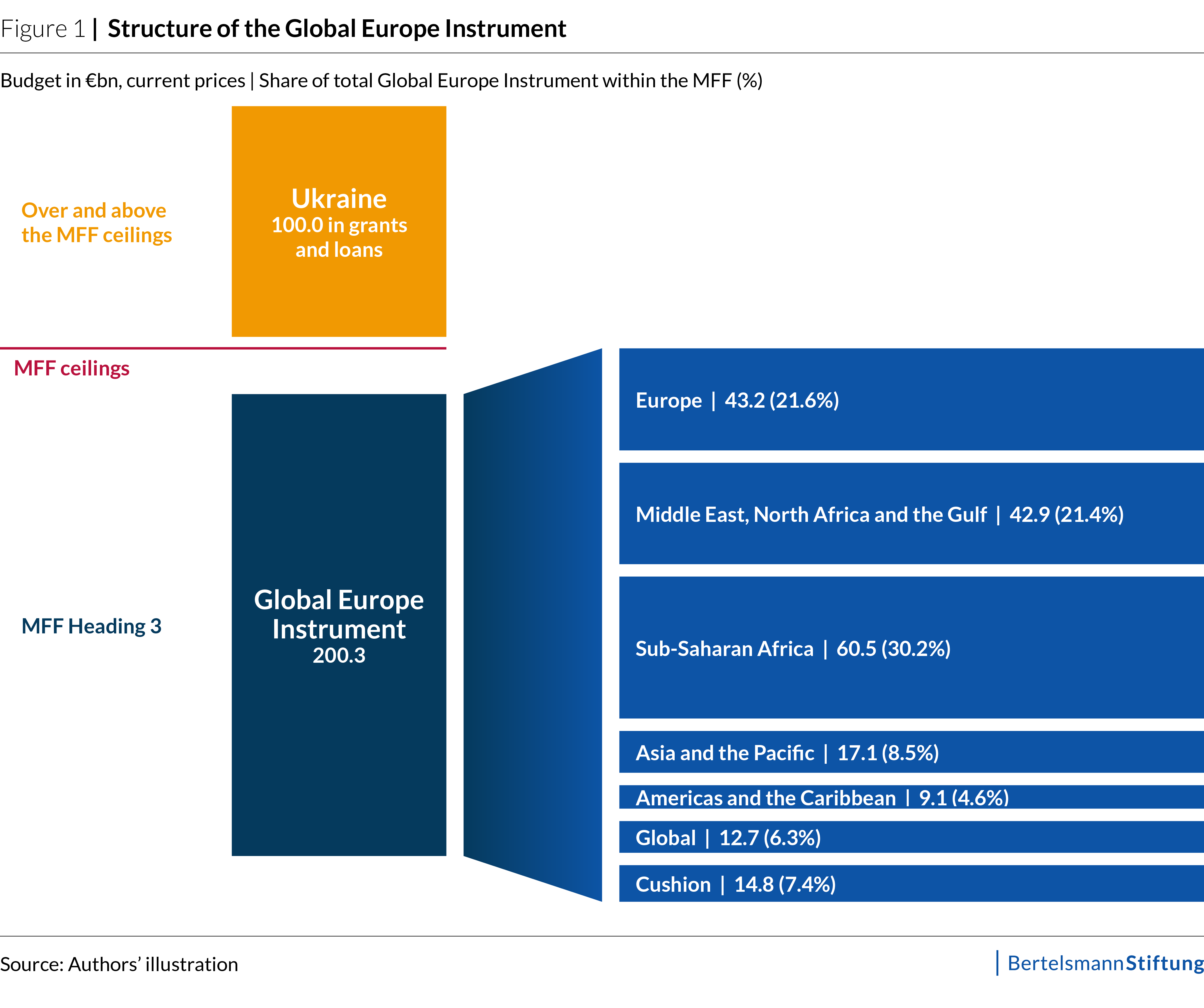
To enhance flexibility, each geographic pillar would combine standard programmable funding with a non-programmable component. In practice, this means that part of the budget would no longer be pre-allocated through multiannual indicative programmes but could instead be mobilised during the MFF period as needs arise. The non-programmable component could support areas such as humanitarian aid, macro-financial assistance, crisis response, resilience and competitiveness measures. However, beyond earmarking €25 billion for humanitarian aid across the pillars, the proposal does not specify how resources would be divided between programmable and non-programmable funding.
At the same time, fixed thematic envelopes and most horizontal spending targets would disappear. Under the current NDICI framework, several thematic pillars exist alongside binding spending benchmarks — for example, for migration, gender equality, human development and climate action. The GEI proposal retains only two quantitative targets: 90% of spending should qualify as official development assistance (ODA), down from 93% today, and 30% should contribute to climate objectives, in line with the MFF’s horizontal performance framework. Other targets would no longer apply as binding percentages. The advantage of this shift is greater flexibility: more decisions would move from the basic legislative act into the implementation phase of the MFF. The trade-off is weaker structural pre-commitment to specific policy areas. During the MFF cycle, the Commission could adjust parameters such as the ODA share through delegated acts, which means EP and Council can both object by majority.
At first glance, the policy objectives of Global Europe appear largely unchanged. Enlargement, neighbourhood policy, international partnerships and humanitarian aid continue to anchor EU external action. As in the 2021–2027 period, the instrument reaffirms core principles such as poverty eradication, human rights, multilateral cooperation and climate action.
The broader narrative, however, shifts in emphasis. External action is framed more explicitly as serving the ‘external dimension of the Union’s internal interests’. A clearer dual objective emerges. Alongside traditional development and foreign policy goals, the instrument is designed to advance EU economic and migration priorities. Economic security, resilience and competitiveness feature more prominently, with a stronger emphasis on coherence with EU trade policy and instruments, including the European Competitiveness Fund. Migration cooperation likewise moves closer to the centre of the instrument’s objectives. The proposal formalises a form of negative conditionality, enabling the Commission to suspend support if partner countries fail to cooperate on the readmission of their nationals. External financing is thus positioned more openly as a tool to advance strategic interests. In doing so, the proposal further blurs the boundary between development cooperation and the EU’s internal and geo-economic priorities.
If Global Europe allows resources to be reallocated across objectives and shifts key spending decisions from the basic act into the implementation phase, governance becomes the central issue. Who decides how flexibility is used? Who determines which objectives are prioritised – and which are not?
The Commission proposes a layered system built around multiannual indicative programmes and annual or multiannual action plans and measures.
Multiannual indicative programmes would determine how the programmable components of the geographic and global pillars are allocated. By design, non-programmable funding would sit outside this framework. These programmes would define priority areas, specific objectives, indicative financial allocations and implementation methods. According to the Commission, a key strength of the new model lies in its ability to tailor programmes to partners’ needs and capacities, with differentiation by region. The programmes would be based on the Commission’s national or regional strategies – framework documents outlining the EU’s overall policy towards each partner – as well as joint documents agreed with partner countries that identify shared priorities and commitments.
Once these programmes are established, implementation would take place through annual or multiannual action plans and measures. In exceptional circumstances, the Commission could also adopt special measures outside the multiannual programmes. Each action plan would specify objectives, expected results, activities, implementation methods, as well as the allocated budget and related support expenditure. The range of implementation tools remains broad, including grants, policy-based loans, budget support and financial instruments. loans, budgetary guarantees, and macro-financial assistance.
The Commission would adopt programmes, action plans and measures through implementing acts under the examination procedure. In practice, this means that Commission proposals must be approved by a committee of Member State representatives. There are, however, important exceptions. For smaller actions – below €10 million for individual measures, €20 million for special measures and €40 million for exceptional assistance measures – as well as for technical amendments and subsidies covering interest rates and borrowing costs, the Commission would be able to decide on its own.
Flexibility is built into these procedures. In urgent situations, the Commission could amend programmes and adopt or revise action plans and measures through immediately applicable implementing acts. In addition, in specific cases, it proposes the possibility of awarding grants directly without a call for proposals. The scope of these cases appears broad, ranging from urgent support for human rights defenders to investment in strategic areas such as critical raw materials, climate resilience or digital infrastructure. The European Court of Auditors has cautioned that such direct awards may weaken principles of competition, transparency and equal treatment.
Four elements of the proposal merit particular attention as negotiations move forward.
- Balancing flexibility with predictability. External action requires adaptability, but it also depends on stable and predictable funding for longer-term strategic objectives. Removing thematic spending targets makes the GEI more flexible – a clear strength of the proposal, yet it also risks leaving some objectives underfunded. Maintaining a 90% ODA target will therefore be essential to preserve the instrument’s focus on the economic and social development of partner countries.
- Greater clarity on programmable versus non-programmable funding. Beyond the €25 billion earmarked for humanitarian aid, it remains unclear how resources will be divided between programmable and non-programmable components. Indicative allocations are needed to assess how the instrument reconciles flexibility with support for longer-term priorities. These allocations should ensure an appropriate balance between the two, taking into account that flexibility is already built into the GEI beyond the non-programmable components – through the cushion, flexible governance arrangements, the possibility to reallocate funds, as well as through flexibility instruments in the overall MFF architecture.
- The role of the European Parliament. Compared with the current framework, the GEI would reduce Parliament’s influence. Key decisions would shift from the basic regulation — negotiated with the European Parliament — to the programming phase, where the Commission would act through implementing rather than delegated acts. One way to partly compensate for this shift, while preserving flexibility, would be to strengthen the annual budget procedure, in which Parliament is co-legislator. The Commission already proposes relatively detailed budget lines for non-programmable funding; extending a similar level of detail to programmable components could help keep Parliament involved in core allocation decisions.
- Robust reporting and evaluation. As most horizontal spending targets disappear, robust reporting and evaluation becomes essential to assess the extent to which the GEI delivers on its wide range of objectives. This requires detailed quantitative data on how funds are allocated, alongside qualitative evidence on progress towards stated goals. The Commission should ensure that such information remains available, even as programme-specific reporting requirements are replaced by a horizontal performance framework. To be effective, this framework will also need clear definitions, as well as policy areas, and intervention fields and indicators that explicitly encompass the EU’s external action.
The Global Europe Instrument is more than a technical redesign of EU external action. It builds on the consolidation introduced in the current budget cycle, but takes simplification a step further. Compared with the 2021–2027 MFF, the proposal streamlines the architecture of external financing, removes most earmarked spending targets, and increases flexibility through non-programmable components and a larger reserve. By shifting key decisions from fixed upfront allocations to the programming phase, the instrument makes it easier to redirect resources as needs evolve. The Commission’s approach clearly prioritises simplification, coherence and flexibility – while aligning external engagement more closely with the EU’s strategic and economic interests. Whether the GEI ultimately provides a credible and balanced framework will depend on how these design choices are shaped during negotiations, and on whether flexibility is matched by clear priorities, safeguards and accountability.
About the authors
Anna Heckhausen works in the Europe programme at the Bertelsmann Stiftung, focusing on issues related to the EU budget.
Katharina Staudte was an intern at the the Bertelsmann Stiftung’s Europe progremme in Berlin from September 2025 to March 2026. Her research interests lie in transatlantic relations and global governance, with a focus on international cooperation and development finance.
Nuoroda į informacijos šaltinį